A collation of further research into the process and making and application of Tadelakt. From research this is the most useful information I’ve come across for a complete beginner, I feel I just need the basics and can experiment with the quantities and ratios after my first attempts.
The products I’ve found online that seem most promising for making Tadelakt in England
As the hydrated lime I did get a little confused by what lime products and such are needed for the process and was close to buying two different products of the same thing but then realised that one is a kind of sticky ‘putty’ and the other a flour like dusty material the Hydrated Lime powder that is available from B&Q and mixed together they make the right stuff for the job!Apparently any type of natural soap can be used for the burnishing process – preferably ‘black olive oil’ soap so I am going to take a risk and give the Dr Organic olive oil soap a go.
And as for the precious stone, I will go into a local Precious Gem Stone shop in Falmouth and see if they have a smooth palm sized piece either Topaz or Quartz as these are the cheapest of the stone types hard enough to be used in the process.
I began reading this attractively thin battered old book in the last week of my month long travels through France, Spain and Portugal. A personal trip post Graduation and pre what the majority of over 40s tell me is life in the ‘real world’. I carried it with me trying not to destroy its bright blue cover any more than it already looks like a crisp packet buried in a river bed for 12 years; tickled by worms and flattened by rocks and it was only until I had enough of writing down my own thoughts that I sought to read someone else’s.
I haven’t actually finished the book yet; the physical book is split into two parts both written by Aldous Huxley: ‘The Doors of Perception’ and ‘Heaven and Hell’. I haven’t found the second part as juicy as the first however, I am only half way through Heaven and Hell so there’s potential for a change in heart for sure. Anyway, I want to type up some of the paragraphs on here that caught by eye before I forget to do so or loose interest for it. So here are a load of zesty chunks from ‘The doors of Perception’ not analysed or explained just observed and appreciated.
Page 3
“Embraced, the lovers desperately try to fuse their insulated ecstasies into a single self-transcendence; in vain. by it’s very nature every embodied spirit is doomed to suffer and enjoy in solitude. Sensations, feelings, insights, fancies – all these are private and, except through symbols and at second hand, incommunicable. We can pool information about experiences, but never the experiences themselves. From family to nation, every human group is a society of island universes”
Page 7 “‘Is-ness.’ The Being of Platonic philosophy” (`Plato)
“a bunch of flowers shining with their own inner light and all but quivering under the pressure of the significance with which they were charged; could never have perceived that what rose or iris and carnation so intensely signified was nothing more , and nothing less, than what they were – a transience that was yet eternal life, a perpetual perishing that was at the same time pure Being, a bundle of minute, unique particulars in which, by some unspeakable and yet self-evident paradox, was to be seen the divine source of all existence.”
Page 9 “the really important facts were that spatial relationships had ceased to matter very much and that my mind was perceiving the world in terms of other than spatial categories”
“In the Mescalin experience the implied question to which the eye responds are of another order… the mind does its perceiving in terms of intensity of existence, profundity of significance, relationships within pattern.”
books glowed with a “living light”
“The mind was primarily concerned, not with measures and locations, but with being and meaning.”
Time: “Plenty of it, but exactly how much was entirely irrelevant.”
Page 11 “To make biological survival possible, Mind at Large has to be funnelled through the reducing valve of the brain and nervous system. What comes out at the other end is a measly trickle of the kind of consciousness which will help us to stay alive on the surface of this particular planet.” – He is saying that as we are animals and our primary need is to survive, although we are capable of experiencing the world in such a way that values being and meaning over measures and productive structures and functions, we do not do this because at survival’s face value it does not benefit or enhance our ability to survive. This page really struck me, even just with the simple notion that our instincts are still so much at the forefront of existence, and control the finest and some of the most interesting of layers of the consciousness (that we know about) is grounding. Here we are thinking we have a grip on consciousness and think we are being all powerful and in touch with the interior but actually within that naive belief that we may have the slightest pinch on the true reality where as actually we are only existing in one physical way of even seeing the world which is the sense and ability we feel most confidently present in.
Page 20
“the world of selves, of time, of moral judgements and utilitarian considerations, the world (and it was this aspect of human life which I wished, above all else, to forget) of self-assertion, of cocksureness, of over-valued words and idolatrously worshipped notions” – I’m guessing because really all these approaches and notions and ways of being are foolish when one encounters a realm of experience so spare of illusion and functions that these emotions and approaches seem like a waste of time and irrelevant to the wider picture.
Page 28 This page was just an interesting informative page about the nature and subject matter of paintings the landscape.
Page 34
“The schizophrenic is a soul not merely unregenerate, but desperately sick into the bargain. His sickness consists in the inability to take refuge from inner and outer reality (as the sane person habitually does) in the homemade universe of common sense – the strictly human world of useful notions, shared symbols and socially acceptable conventions. The schizophrenic is like a man permanently under the influence of mescalin, and therefore unable to shut off the experience of a reality which he is not holy enough to wive with, which he cannot explain away because it is the most stubborn of primary facts, and which because it never permits him to look at the world through merely human eyes, scares him into interpreting its unremitting strangeness, its burning intensity of significance, as the manifestations of human or even cosmic malevolence, calling for the most desperate counter-measures, from murderous violence at one end of the scale to catatonia, or psychological suicide, at the other.”
– this is a pretty mental paragraph but I think I can gage the point about the excruciatingly mind-boggling disorder of experiencing the world with such intensity and vulnerability to its extreme presence and how this may cause uncontrollable power and how misaligned this is with the rest of society and there for cause chaotic actions and result in a complete lack of connection to others and people who cannot empathise or comprehend such an experience of the world.
Page 47
“Literary or scientific, liberal or specialist, all our education is predominantly verbal and therefore fails to accomplish what it is supposed to do. Instead of transforming children into fully developed adults, it turns out students of the natural sciences who are completely unaware of Nature as the primary fact or experience, it inflicts upon the world students of the Humanities who know nothing of humanity, their own or anyone else’s.”
Page 59
“our perceptions of the external world are habitually clouded by the verbal notions in terms of which we do our thinking. We are for ever attempting to convert things into signs for the more intelligible abstractions of our own invention, But in doing so, we rob these things of a great deal of their native thinghood.”
“It is entirely natural – entirely natural in the sense of being entirely unsophisticated by language or the scientific, philosophical and utilitarian notions, by means of which we ordinarily re-create the given world in our own drearily human image.”
Page 69
“sacred jewellery has always been associated with the light of lamps and candles. For Ezekiel, a gem was a stone of fire. Conversely, a flame is a living gem, endowed with all the transporting power that belongs to the precious stone and, to a lesser degree, to polished metal. This transporting power of flame increases in proportion to the depth and extent of the surrounding darkness. The most impressively numinous temples are caverns of twilight, in which a few tapers give life to the transporting, other-worldly treasures on the alter.”
So the originally Moroccan natural building material and process of Tadelakt is something I have recently come across while volunteering to build a house in the Beira Baixa province of Portugal. I have never heard it mentioned in England before so it feels very exciting to discover a potential new sculptural material that I don’t think many artist in the UK have explored.
“The word Tadelakt comes from the verb “dalaka”, which in Arabic means to rub, to caress, to massage or to flatten. In addition, Tadelakt is the Berber pronunciation of the name Dalk”
So Tadelakt is water proof, natural and can be moulded and shaped around anything and in any shape which just instantly makes me think of how much of an amazing potential this material could have for sculptures, rather than using say metal or concrete or something that won’t decompose plus it can be an outdoor sculpture because it won’t get destroyed in the rain or wind or snow. Also if it does get damaged it could be interesting to sea the change in the colour and weathering it faces especially in a wet place like England opposed to Morocco where it originated!
Photo taken by Carlos Barrero – looks quite Gaudi esk!
Often used in bathrooms because it is water proof. Made from natural hydraulic lime, quartz and marble. Tadelakt is naturally white in color and can be pigmented to varying intensities using natural colour earth pigments creating spectacular intense patinas . Like the building below you can see how glass bottles have been incorporated in the walls made from cob plus other materials like wood have been merged into the walls and building – I could easily do this with sculptures that incorporate other organic matte or waste materials in them, could even hold candles or be used and designed as fire pits or wash bowls.
From what I could find on a quick google search for artists using Tadelakt the below forms were the old art like sculptures that I found! All otherwise were examples of how the material has been used practically with bathrooms and in interior design which suggests that it would be quite an individual material to use for sculpture and art works, plus I believe it is probably easy to paint on.
Things I could make from Tadelakt:
Bowls, plates, cups, mugs, spoons (done around cheap wooden spoons) washing up bowls, extravagant arty bowls and vessels sinks, baths, general interior general organic blobby arty sculptures that incorporate glass and wood etc. anything I find candle holders, extravagant large candle holders
furniture like tables and chairs just by building around existing cheap second hand/found furniture stuff with interesting organic additional shapes or whatever – just be experimental with it!
Organic and interesting shaped plinths for art galleriesand artists like those in the image above
Notes: The natural colour of tadelakt is white and looks quite rustic You will need natural colour pigments to die the tadelakt mixture which could be found in local clay quarries and I could make my own natural pigments from beetroot or paprika, clay, seaweed etc. It is a long process so cost a lot of time and effort which means can be sold at high price I could collect and use clay and mud for the first under layers of cob from local quarries – could be serious part of context and process linking it to Cornwall. It is a technique that I could become a master of and run workshops in – it is something different that I haven’t heard of sculptural workshops being done in it before!
So in light of this material discovery: yesterday I was to be flying back to England next week, and today I think I might stop in Marrakech for a few days for some photographing, spice hauling and tadelakt researching!
Paul Chaney website: http://www.paulchaney.co.uk/ Interesting snippet form page about his current work at Goonhilly Earth Centre, Cornwall…
I’ve never considered that of course the land that is left and therefor available for communities and people in need is the waste land and ruined land that has been destroyed for some other reason and cast out of value, ie the dregs of land.
Kestle Barton (http://www.kestlebarton.co.uk/) the small art space near Helford Passage in Cornwall does a good job at covering interesting and needed subjects through art and bringing people together for discussion and learning! Which is the direction I hope contemporary art goes; not just down here in the Celtic country but up country and in Urban areas also. This series of talks and events led by experts in the field of low impact development have been happening throughout July but I’ve only just heard about them, so I’ll go to the last one on Sunday.
Really positive that these talks will inform people about the legal side of development and the realistic side of how we can push this movement for the better of the natural world and wellbeing of society – this sort of thing needs to be repeated throughout art centres and in schools and businesses everywhere – good idea to set something like this up – pushing adult forest school kind of stuff – the direction art is heading towards community development and engagement and so on.
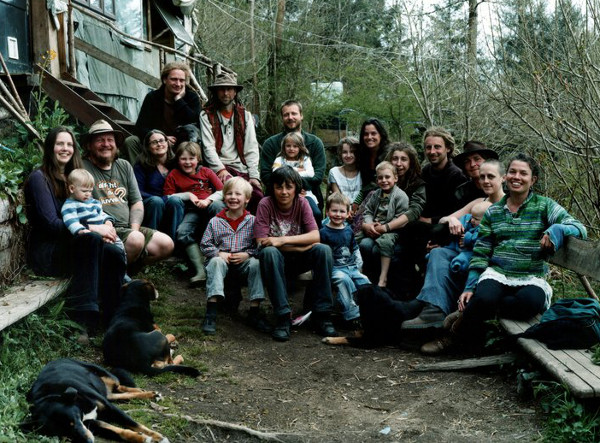
What is the Steward Wood phenomena then?
By the look of things they are going through some issues with land ownership similar to the issues Native American and Canadian groups constant face and are battling with. The authorities and government have and continue to totally screw over Natives and demolish their rights to acres and acres of forests that have been their homes and place of worship for thousands of years long before colonialism.
Obviously there are huge differences and it is highly problematic to liken Native Americans and Canadians with this story of Steward Wood but what is similar is the forever discarded kindness and possible symbiosis of humans living very closely to nature. It seems this argument and belief is never heard, valued or seen as a worthy cause.
People who have found a way of living beside and with nature, found their groove and want to maintain and improve that relationship that is more sustainable and hopefully not harmful for the environment. An example and one of the first of this kind of movement – setting an example for the rest of us.
“misunderstood intentions and ideologies”
“sociopolitical conditions leading to the formation of precarious intensional communities under the conditions of late capitalism”
– Movements from the ground up, starting at the ‘bottom of society’ hence the roots idea.
I think it would be good for us all to attend such talks with such dense reasoning and honesty for the benefit of simply understanding. Knowledge gives way to change.
consider instructions and order of science and introduce, collabortate instructions and diagrams and order into drawings and collages representing freedom.
the usefulness of diagrams and instructions
Art should represent its relationship with science Art and science – art and diagram
Diagram often suggest the presence of line and order are line drawings diagrams strong line and look drawing diagrammatic essence demonstrating the properties of such, not the essence or feeling
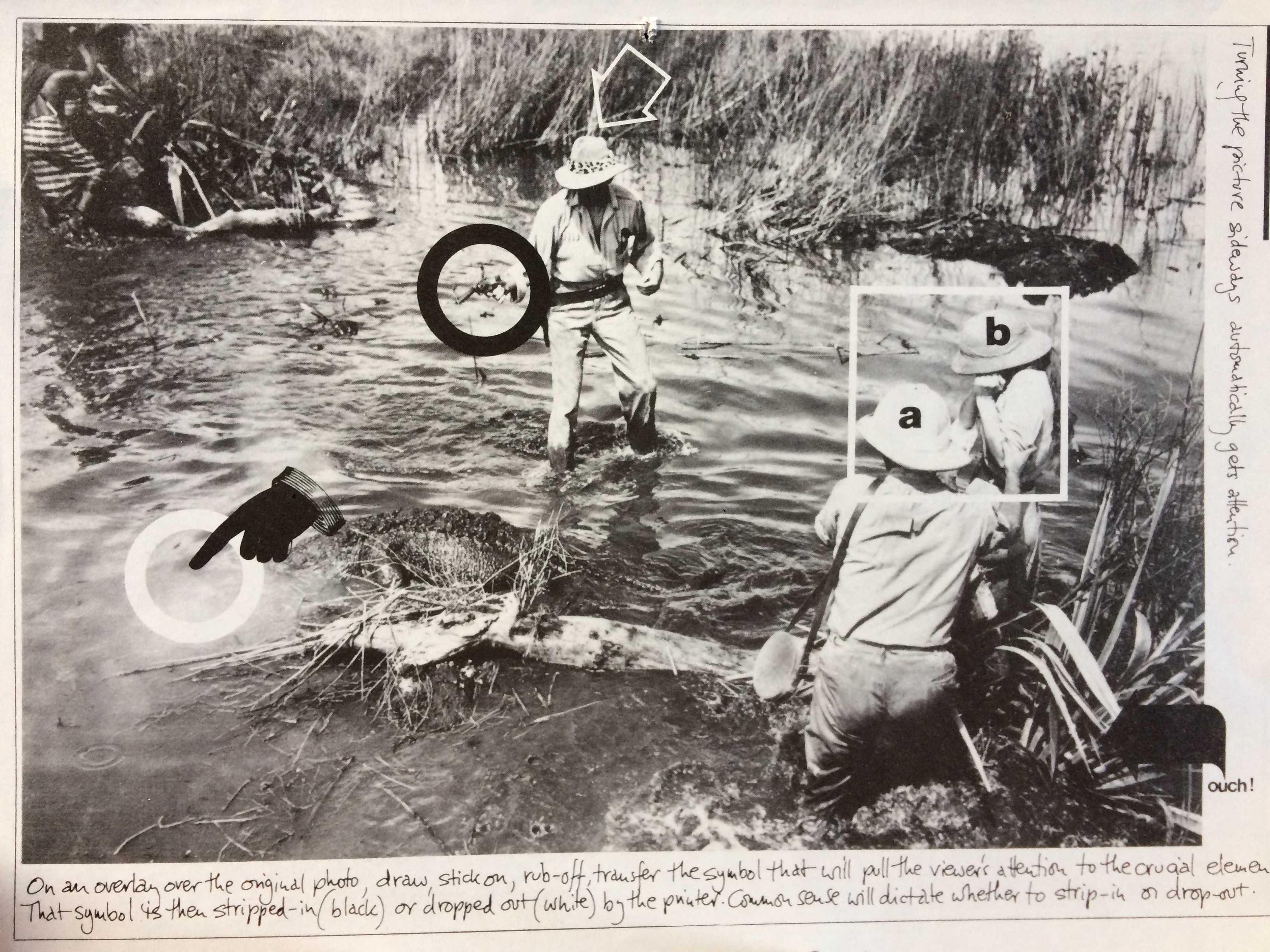
The image above was from a Graphics help book I found for free outside the library ages ago and this images from it has reoccured in my thoughts and inspiration since. It has just been transferred and transferred into piles of paper each time I start a new project – never gets forgotten or left behind and i still don’t know why…
The way it maps the image capturing an organic moment is intriguing and combines human order and our diagrammatic obsession with an image captured outside in a moment that lacks control or predetermination as it is a photo of people in a bog disturbing a crocodile.
The initial combination of artistic layers is juxtaposing and I’d like to try to recreate this with some of my own photographs or stills from films – interesting element that films have been orchestrated – maybe I should take photos of the public at random? But again like in previous debates I’ve had with myself; any photo taken is determined and passed through the eye of the person behind the camera so can never be unbiased to subject or shot unless done blindfolded? — Interesting idea to study people blindfolded or under certain set conditions that avoid prejudice.
hammer or bend metal directly around stone or wood whether its practical or not
honouring both masculine and feminine principles in objects, architecture and philosophy. It is really nice the variety of craft whether physical or metaphorical – crafting gatherings or places of gathering as well as crafting objects , being out on the land, feeling object and listening . feeling the origin of which things originate
listening to materials and honouring their intelligence like the trees and ancient metals the delicate and frail beside box and solidity, structure and certainty beside the uncertain and sacred
a few paragraphs about the building or space he has made and then list of materials – how a maker and architect does it with enchanting descriptions that believe in themselves
“teaching joinery skills through the making of the space” “reclaimed wood”
– sharing knowledge and doing so onsite not in the class room or office or through technology, unearthing handheld knowledge from within about wood and creations – reusing and finding and allowing for the shape and nature of the materials and found wood to determine the texture and sense of the finished growing space not being too precious with perfect conditioned wood or shapes – simplicity, boxiness and plywood doesn’t hinder the finished space
deeper senses, deeper flow,, deeper feeling and connection different trees represent different things in all religions
Paganism is an ancient religion and people seem to be
radical awe to our relationship to god
forest bathing – out in the woods, cleansing, touching the trees
theres a lot of people leaving the church as its uncomfortable for them and moving to more earth beliefs and spirituality
forest church
people’s stress levels lower in the forest than in the church – science is now pushing this and supporting this
increase canopy cover, decrease prescriptions for depression
immune system improved outside
the forest church is spreading, the movement at the moment with people trying to connect to nature further
trees communicate through the roots, Ewe trees communicate through fungus, they release pheromones to warn other trees about risks and predators and send electrical signals to other trees suggesting maybe they send and communicate with us as well which is why we feel so much more at ease when in the woods, it was where we lived and settled for thousands of years in some parts of the world, we are deeply connected to them!
we live on a very short time scale compared to trees so how can we really know or feel into understanding them, they are different creatures to us, we will never see the result of those trees by one person
we need to stop assuming we are the most intelligent beings on this earth, need to respect all the other intelligence around us
we could not survive as a race without trees
the Rowan tree has much spiritual connection in Celtic mythology is a very important tree, it is always represented as the tree that protects you from magic and holds much of its own magic, sign of magic occurring or protection against magic






 L A M O I N E